
An important premise: there is NO such thing as a perfect pricing structure, because nothing in marketing is perfect
The best way to design it depends on a range of factors and variables. However, the recommendations we are sharing are based on 15 years of experience in the industry, the analysis of countless pricing structures and conversations with thousands of clients we have worked with.
In other words, we have observed which models proved most profitable after businesses moved away from traditional solutions, such as memberships, and adopted credit-based models.
Your pricing is your first sales tool — your silent salesperson
The perfect pricing structure is not the one with the greatest number of items or options. It is the one that removes uncertainty, encourages clients to buy and has the following characteristics:
1️⃣ It is simple: clients should understand it within seconds, without needing an explanation.
2️⃣ The choice should be based on how much clients want to spend, not on the type of activity. With a few occasional exceptions, every option should cover all activities.
3️⃣ It must be visible and available to purchase in the app.
Most importantly, it must NOT be based on memberships, but on credit packages with an expiry date.
BookyWay’s expiring credits make this easy:
1 credit = 1 unit of currency,
a single class as a trial option, packages with progressive discounts, clarity across multiple activities and currencies, and transparent validity rules.
In the following sections, we will explain how to build a pricing structure that will increase your revenue: mapping your activities, matching credits to currency, why you should always sell a single class and how to create expiring packages that clients can understand — and want to buy — at a glance.
Why use a credit-based model instead of memberships?
Because more than a decade of experience with thousands of clients using BookyWay has shown us that the credit model is more effective than the membership model.If you already understand this, you can skip straight to the next section, “How to create your pricing structure”. Otherwise, we recommend reading what we have learnt over the years.
🎯 The same cost and validity period as a membership for the client, but with significant additional benefits
Example:
Before: €80 per month for two classes a week, at €10 per class.
After: 80 credits = €80, valid for one month, allowing the client to attend eight classes costing €10 = 10 credits each.
So what are the benefits for the client and the manager?
- The frustrating weekly limit disappears: clients can attend whenever they choose.
- Clients can use all their credits before the expiry date and purchase a new package before the previous one expires. A membership, by contrast, would only be renewed at the end of its validity period.
- Unlike memberships, several credit packages with different expiry dates can coexist. Clients can purchase a new package before the previous one expires so that they can book future classes — which also means they are likely to spend more.
🐍 Flexibility
Packages containing the same number of credits can be priced differently according to their validity period: a longer validity period carries a higher price, while a shorter one costs less.You can also keep the overall pricing structure unchanged while encouraging clients to book quieter time slots. Simply adjust the number of credits required for classes at those times without changing the price of the packages.
💜 Client retention
Clients can try different activities without being tied to one specific type of membership. If they do not enjoy an activity, they can use their credits to try something else, improving retention and reducing the risk of dissatisfaction.
💸 Reducing the association with money
As happens at holiday resorts, converting money into credits reduces the feeling of spending actual money. Clients are therefore more inclined to use services without the psychological weight of paying for every individual purchase.
👫 Accessibility for new clients
Credits allow new clients to purchase only the activities they want — even a single class — and spend less than they would on a full membership. This encourages people to try your business without a major initial financial commitment.
🗣 Lead generation
Credits make it possible to create more targeted promotional campaigns. For example, you can build a landing page that offers a small complimentary credit package in exchange for a potential client’s details. This makes lead generation easier and encourages prospects to access the app and try your services.
🫰🏼 A lower perceived cost
Because of its flexible nature, paying with credits often requires a lower initial outlay than purchasing a membership. Psychologically, this makes clients more comfortable completing the purchase without fearing an excessive commitment, increasing the likelihood of conversion.
🏄🏻♂️ Promoting new services
Credits already available in a client’s wallet can encourage them to try new activities or events spontaneously, without the need for complex promotional campaigns. Immediate access makes clients more likely to experiment with the new services you offer.
🚴🏻♂️ Creating extra experiences and incentives
A credit system allows managers to offer special experiences beyond regular classes, such as a social dinner, a group outing or an exclusive event. Clients can purchase these extras using credits already in their wallet, adding value and making their overall experience more complete and engaging. These initiatives also strengthen the sense of community and participation, giving clients another reason to remain active within your business.
In this article, we explain how to build a clear and effective credit-based pricing structure. The same principles also apply to non-fitness businesses — driving schools, dog-training courses, music and language schools, webinars, bookshops and many others. A credit is a neutral unit that makes it easy to manage different prices through a single wallet.
What we do not cover here
We will not discuss the exact price of individual activities or the precise discounts to apply to packages. These depend on variables such as course quality, location, facilities, target audience, market and competitors, instructor reputation and capacity. Our purpose here is to establish the method for structuring your pricing.
How to create your pricing structure — a practical example
Step 1 — Map your activities
Start by identifying all the activities you plan to include in your schedule — for example, Yoga, Pilates and One-to-One — together with their calendar programming.
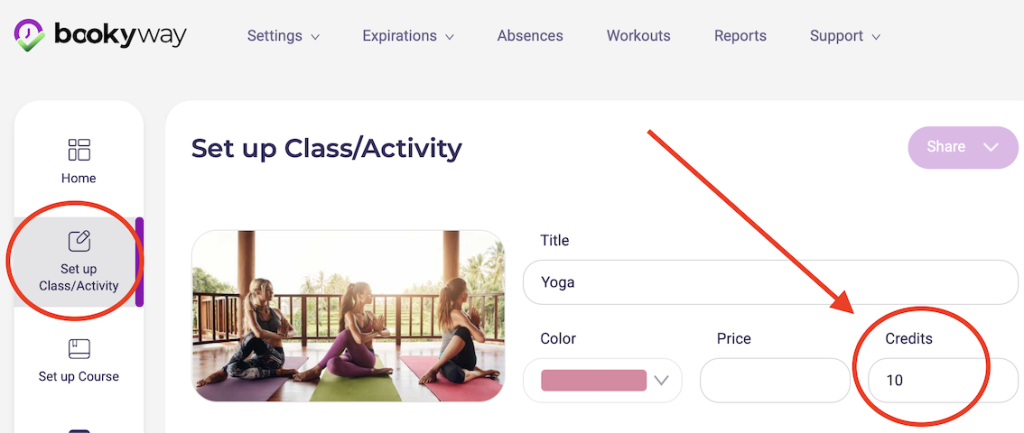
Step 2 — Credit value = monetary value
Assign each activity a value in credits equal to its price in your currency (EUR, CHF, GBP and so on).
Example in EUR: if Yoga costs €10, assign it a value of 10 credits.
Why is this essential?
- Managing activities with different prices. Even if you currently offer only one activity, you are very likely to add others in the future — perhaps even a one-off event — and they may have different prices.
- Immediate transparency for clients: 1 credit ≈ 1 unit of currency.
- Easy-to-understand package discounts: the cost per credit decreases as the package size increases.
- Consistency across countries: you can change currency without rewriting the pricing logic.
- Clear reporting: conversions and revenue per credit are easy to analyse.
Avoid “1 credit for everything” pricing: it prevents you from differentiating correctly between activities with different values.
In addition to packages, always offer a single class:
- It provides an easy trial option, lowering the barrier to purchase.
- It reduces commitment anxiety for new clients.
- It increases the conversion rate from initial enquiry to paying client.
Always sell the single-class option as well
Step 3 — Create credit packages, not class packages
Now create your credit-based pricing in the BookyWay Shop, applying progressively larger discounts to higher-value credit packages.
See HERE why selling credit packages rather than class packages is more beneficial for both you and your clients
Let’s look at a practical example
We have selected three activities purely for illustration. You will naturally use the activities offered by your own business. This first section of the pricing structure allows clients to purchase a single class as well.
Base prices — examples in EUR only:
Yoga — Single class = 10 credits = €10
Pilates — Single class = 15 credits = €15
One-to-One — Single session = 20 credits = €20
We would therefore begin by creating the pricing structure in the SHOP section of BookyWay as follows:
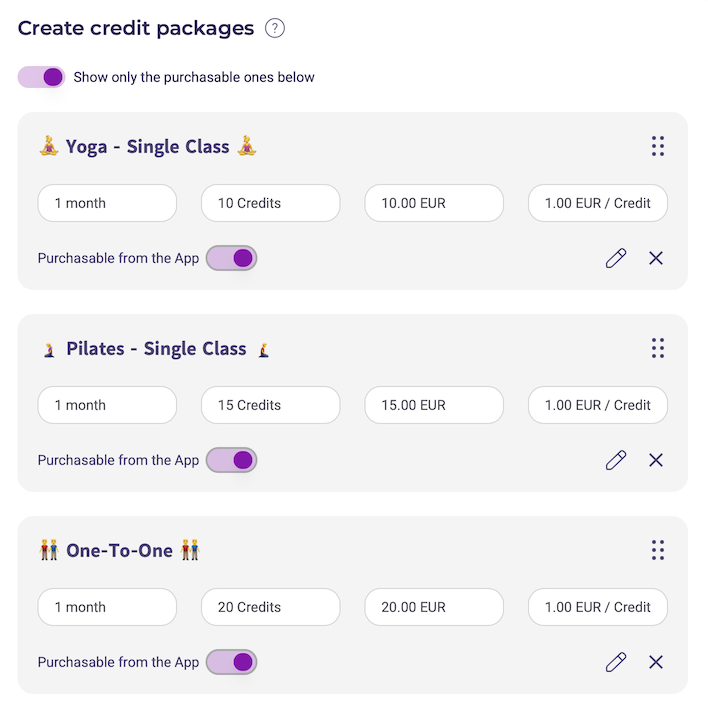
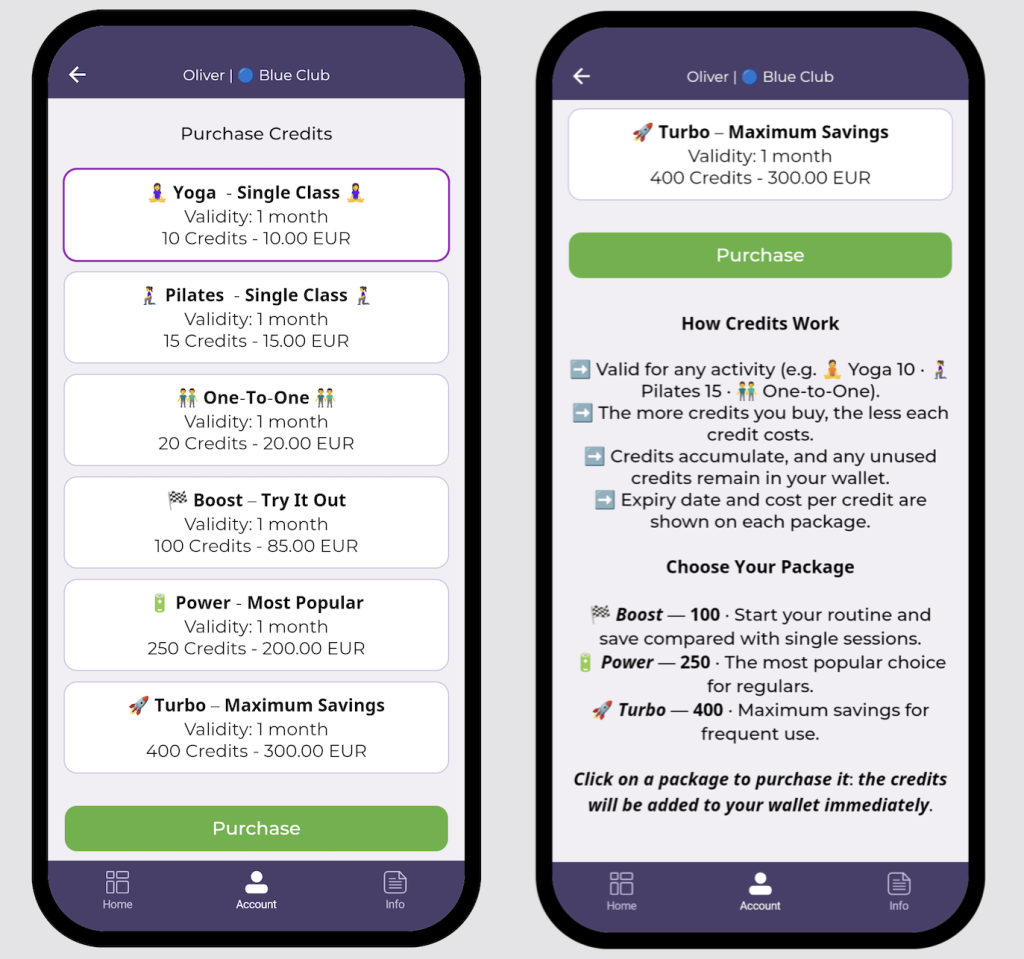
In this case, we have included the name of a specific class in the package because clients can use all those credits for the corresponding activity. However, in the packages that follow we will NOT include the activity name. Instead, we will encourage the purchase based on the discount applied to the number of credits, not on the number of classes.
Now we can encourage clients to buy by offering discounted credit packages, for example:
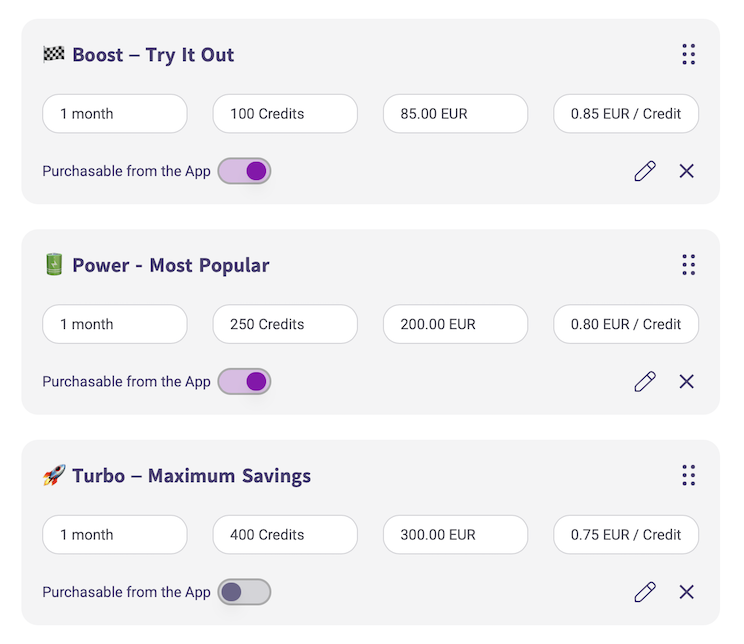
100 credits = €85 (€0.85 per credit)
What can a client do with 100 credits? Attend 10 Yoga classes; six Pilates classes with 10 credits remaining; five One-to-One sessions with no credits remaining; or three Yoga classes, two Pilates classes and two One-to-One sessions with no credits remaining — and so on.
250 credits = €200 (€0.80 per credit)
400 credits = €300 (€0.75 per credit)
Clients will naturally tend to purchase a package whose credits they can use up by attending a particular activity, so it is your responsibility to design the pricing with this in mind. However, it is essential to remember that you are selling credit packages rather than class packages. Therefore, it is entirely normal for clients who can book different activities with the same package to have unused credits left over. Those credits will simply be added to their next purchase.
As shown in the image below, when this pricing is configured in the BookyWay Shop, the right-hand column displays the price per credit. This figure should always decrease as the size of the package increases. In other words, larger packages should carry a greater discount to encourage clients to buy them.
Naming your packages helps communicate the character of each option, while the description allows you to explain clearly what clients will be able to book after purchasing a particular package.
All that remains is to create the explanatory text that clients will see in the app Shop. For example:
How credits work
1 credit ≈ 1 unit of currency
- Valid for any activity — for example, Yoga 10 · Pilates 15 · One-to-One 20.
- The more credits you buy, the less each credit costs.
- Credits accumulate, and unused credits remain in your wallet.Each package displays its expiry date and cost per credit.
Choose your package
- 🏁 Boost — 100 · Start your routine and save compared with single classes.
- 🔋 Power — 250 · The most popular choice among frequent clients.
- 🚀 Turbo — 400 · Maximum savings for intensive use.
Tap a package to purchase it: the credits will appear in your wallet immediately
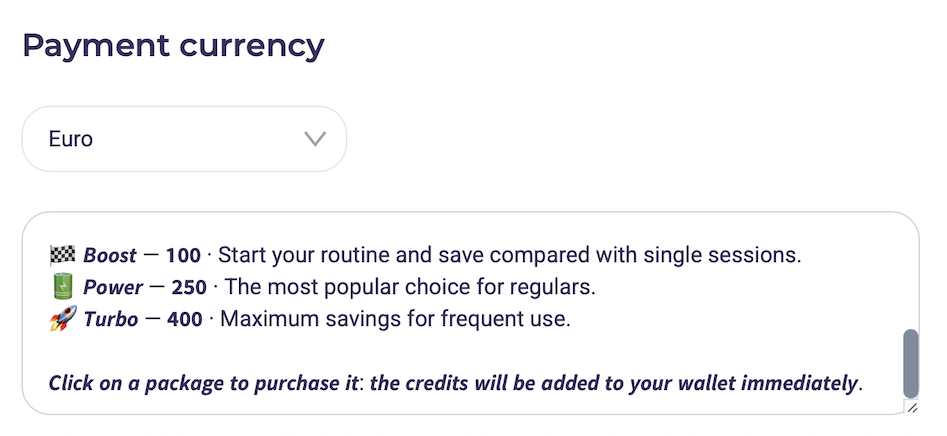
And here is your new pricing structure, just as your clients will see it in the app
How should expiry dates be assigned, and how do they work?
Assigning an expiry date to every package is essential. It is what allows us to use packages instead of traditional memberships.
As a general rule, assign the same validity period that you would previously have applied to a membership at that price.
Managing package expiry dates also allows you to offer the same credit package at different prices according to its validity period.Example:
Take the package:
🏁 Boost — 100 credits = €85 — valid for one month
You could create two alternatives:
🏁 Boost 2 Months — 100 credits = €93 — valid for two months
🏁 Boost 15 Days — 100 credits = €80 — valid for 15 days
How are packages assigned?
If payment is made at reception
- The client pays for a credit package at reception.
- The manager opens the client’s profile and adds the credits, either by selecting a package already saved in the Shop or by creating a custom one.
If payment is made through the app — recommended
Clients can view and purchase packages from the Account section of the app. Alternatively, if they do not have enough credits while booking an activity, the app will automatically invite them to purchase a package.
Click here to see why enabling in-app payments is an advantage rather than a cost — despite the transaction fees — complete with a mathematical demonstration
Click here to watch the complete video tutorial on creating expiring credit packages
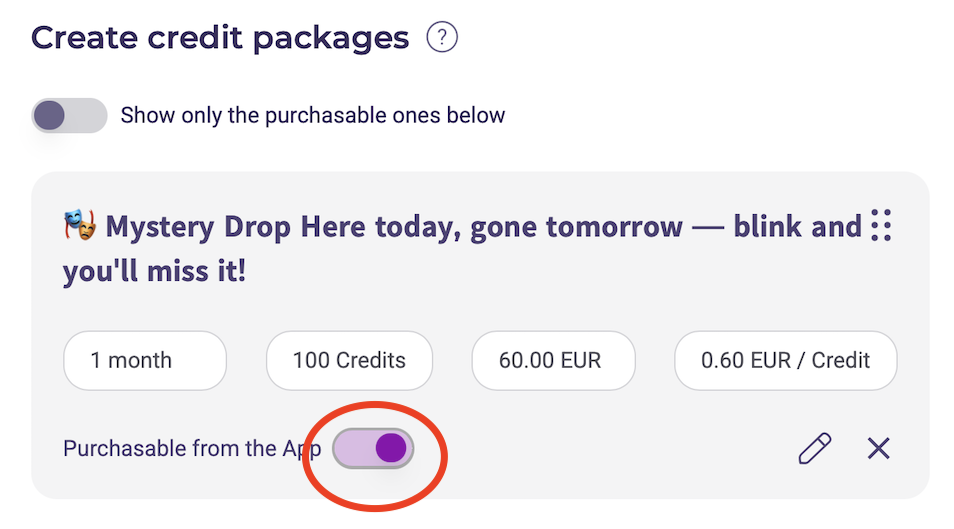
Tips & Tricks #1 – Create occasional, seasonal or limited-visibility packages to encourage purchases during lower-revenue periods
For example, you could create a package called:
🎁 Surprise Offer
Here today, gone tomorrow — don’t miss it!
and give it a larger discount than your other packages.
In the BookyWay Shop, a single button lets you decide when the package should be visible or hidden in your clients’ app.
This makes the promotion more than simply a good deal: it becomes a small game of discovery.
You can announce that the offer is coming a few days in advance without revealing exactly when it will appear, then promote it through a push notification. This encourages clients to open the app more often to look for it. While doing so, they will also see your newly published activities, increasing opportunities for bookings and interaction with your business.
Tips & Tricks #2 – Temporarily reduce the credit price of quieter time slots
At sports centres, some time slots fill up easily while others risk remaining empty. You can run a temporary experiment by reducing the number of credits required during quieter hours. For example, for one month, Yoga at 7:00 and 10:00 could drop from 10 credits to 8.
Promote the change with a push notification as well. The saving may persuade some clients to move away from crowded time slots, reducing waiting lists and filling less popular sessions.
The important thing is to treat this as an experiment: monitor the results and make sure your main time slots continue to attract healthy demand before deciding whether to make the change permanent.
You can do all this without changing the value of the packages available for purchase.
Tips & Tricks #3 – Icons, emphasis and formatting
Emoji: why and how to use them
- Why: they guide the eye and make the pricing easier to scan and recognise.
- How: use one emoji at the beginning of the title, with an optional second emoji at the end. Always use the same emoji for the same category or package.
Maximum: one or two per line. Never rely on an emoji alone to communicate essential information. - Example: Yoga — Single class (10 credits) · Trial
Text formatting — bold
- Why: it highlights one or two key phrases, such as “cost per credit” or “Maximum savings”.
- How to do it in BookyWay: there is no native bold formatting, so paste text that has already been formatted using a social-media text editor or bold/italic text generator.
- Use it sparingly: highlight only a few words, not entire sentences.
- If bold text is not displayed correctly, use this fallback option, which works on all phones:
- Write important words in CAPITAL LETTERS or place them inside [square brackets]. You can also add an emoji before them.
- Quick test: check the result on both iOS and Android. If you see unusual characters or empty squares, switch to the fallback option immediately.
Click HERE to watch the video tutorial on managing credit packages with BookyWay